Claude Fable 5.1 makes context worth protecting
September 23 update: Claude Opus 5.5 is here: pricing and the three-minute review problem. The analysis below covers the earlier release at its original source-check date.
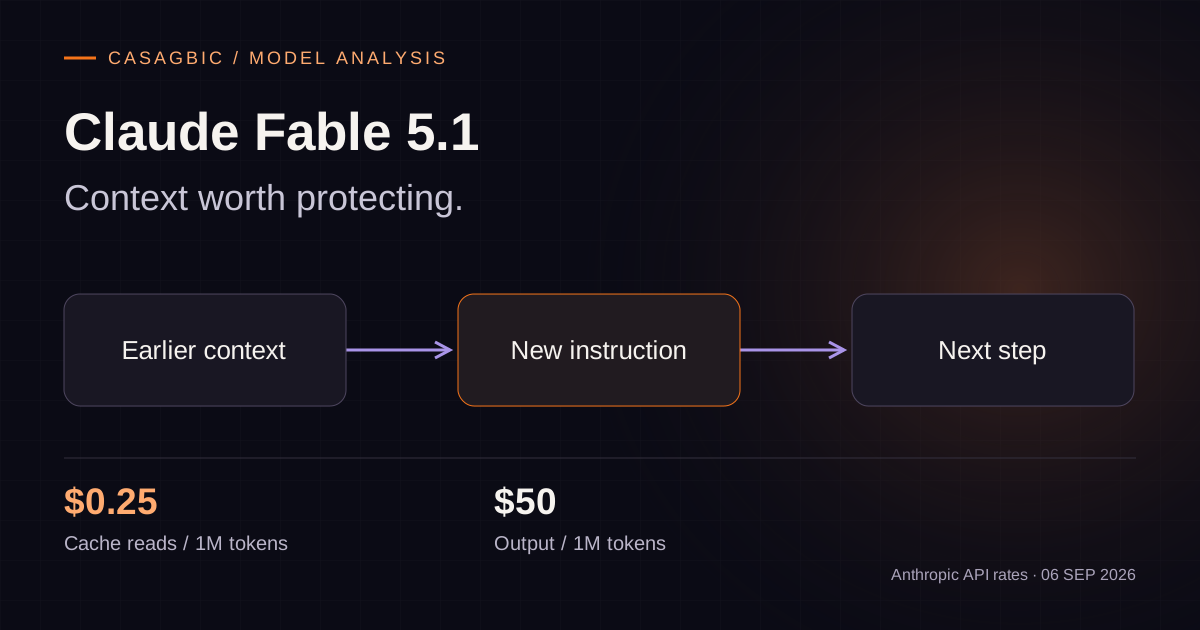
Claude Fable 5.1 lowers the price of reading cached context while tightening the rules for changing that context. For a coding agent that works across a long session, those two changes belong in the same conversation.
Anthropic released Fable 5.1 on September 1, 2026. Its standard Claude API rates are $10 per million input tokens and $50 per million output tokens, with cache reads at $0.25 per million. It has a 1M-token context window and a 128K-token output limit. Those specifications establish what you can buy. The less obvious question is how much of the work your application can carry forward.
Claude Fable 5.1 pricing: the discount is on reuse
Cache reads fell from $1 to $0.25 per million tokens; input, output, and cache-write rates did not change from Fable 5. A cached read reuses a matching prefix that the service has already processed. Writing that cache and generating a new answer have separate prices.
| Token category | Fable 5 | Fable 5.1 |
|---|---|---|
| Uncached input | $10 | $10 |
| 5-minute cache write | $12.50 | $12.50 |
| 1-hour cache write | $20 | $20 |
| Cache read | $1 | $0.25 |
| Output | $50 | $50 |
Source: Anthropic's pricing and migration notes. Standard token rates apply across the 1M context window. Batch input/output rates are $5/$25. Tool charges and applicable data-residency pricing are separate.
The launch announcement reports around 25% lower costs for typical workloads and up to approximately 45% for highly agentic workloads. Anthropic bases that comparison on four weeks of August usage at default effort. Those are provider-reported workload results, not a discount that applies to every invoice.
You can isolate the pricing change without inventing a workload. If you reprice exactly the same token ledger, the saving is $0.75 for each million cache-read tokens. Equivalently, the reduction in the old total bill is 75% of the share previously spent on cache reads. Changes in output volume, retries, effort, tool usage, or cache hits require a new calculation.
One output token costs as much as 200 cache-read tokens
The relationship between the two rates is more useful than the headline discount alone. At $50 per million output tokens and $0.25 per million cache-read tokens, generating a token costs 200 times as much as reading a cached token.
200 : 1Output price per token : cached-input price per token
Another way to read the same arithmetic: 15,000 additional output tokens cost $0.75, equal to the Fable 5 → 5.1 saving on one million cache-read tokens.
This is a calculation from published rates, not a performance test or a prediction about a particular session.
That comparison matters because Anthropic's behavior notes say Fable 5.1 is more likely to rewrite an entire text file for a small edit. The documentation also says independent tool calls may be spread across more turns unless batching is explicit. Whole-file output and extra turns can change the bill even when the final answer is equally useful.
For a coding workflow, this gives you a concrete review question: did the model produce the smallest useful change, with enough evidence to review it? Ask for targeted edits when the task is local. Let independent reads run together when they can. Keep the stable reference material that makes a session productive. These recommendations follow the documented behavior; they do not require assuming that a model upgrade will save a fixed percentage.
A long context window has three different boundaries
A 1M-token window tells you how much the model can accept. It does not tell you whether an application can rewrite earlier turns or move reasoning between models. Fable 5.1 makes those distinctions explicit.
1. Earlier history affects the validity of later thinking
Changing the system prompt, tool definitions, or an earlier message can invalidate Fable 5.1 thinking blocks that follow it. Replaying an invalid block can produce a 400 error. This check is enforced for accounts created on or after August 31, 2026; for older accounts, the documented behavior depends on whether the request sets the relevant mismatch control.
This is a rule about preserved thinking blocks, not a claim that every ordinary text message disappears. The practical implication for a custom agent is to preserve the earlier conversation and append new instructions. Anthropic lists mid-conversation system messages, mid-conversation tool changes, server-side context editing, and compaction as supported ways to manage a session.
2. Model switching preserves thinking in one direction
Fable 5.1 can read earlier Claude models' thinking blocks. Earlier models cannot read Fable 5.1's. If a router switches a conversation back to an earlier model, incompatible blocks are dropped before that model sees them. Dropped blocks are not billed as input.
With the documented thinking-binding-controls-2026-08-01 beta header, those drops are reported in input_transformations. Without it, a drop can be silent. A fallback can therefore succeed as an API request while carrying forward less reasoning than the application expects.
3. A temporary instruction still needs a stable history
A reminder that applies only to the next task should not require editing and deleting an older message. Fable 5.1's turn-scoped system messages address that case: clear_at: "next_user_message" ends the instruction's effect after a later user message while retaining the original message in the transcript. This feature is in beta.
- Keep the previous transcript intact. Preserve thinking blocks and the context before them.
- Append the new requirement. Use the supported mid-conversation controls for instructions, tools, or effort.
- Trim through the supported context tools. Use server-side compaction or context editing when a session grows.
The common thread is continuity. The same documentation connects these patterns to keeping both thinking valid and the prompt cache reusable. That makes history management a product concern, especially when users return to an unfinished task or add a requirement halfway through a project.
What to check before changing the model ID
The Claude API model ID is claude-fable-5-1. Amazon Bedrock uses anthropic.claude-fable-5-1. The official model page also lists Google Cloud, Microsoft Foundry, and Claude Platform on AWS. For a custom integration, test the behaviors below before routing existing sessions to the new model.
| Existing behavior | What to verify |
|---|---|
| Force a named tool or any tool | tool_choice values tool and any return a 400 error. Use auto with strict tool schemas, or structured outputs for a JSON response. |
| Rewrite old messages between calls | Check whether later thinking blocks become invalid. Move changing instructions into supported mid-conversation messages. |
| Route a session to an older model | Observe thinking-block drops and make sure the fallback has the task facts it needs. |
| Show only ordinary text as progress | The beta thinking.display: "updates" exposes status updates between tool calls while reasoning stays hidden. |
| Use low effort for current research | Anthropic reports less frequent search/retrieval at the lowest effort. Explicitly require verification of current claims and check source use. |
Strict tool schemas constrain arguments; they do not restore forced tool selection. Likewise, exposing progress updates does not make updates more frequent by itself. Anthropic recommends explicitly asking for user-facing progress when the interface depends on it.
These history concerns apply most directly when your own code constructs the message array. Anthropic says Claude Code, claude.ai, Claude Managed Agents, and the Claude Agent SDK preserve the prefix for you. Organizations with retention requirements should also check the current terms: the docs specify 30-day retention unless Anthropic expressly authorizes zero data retention.
Where Fable 5.1 fits beside Opus 5 and Astra
Anthropic still recommends starting with Claude Opus 5 for most workloads, then choosing Fable 5.1 for demanding reasoning or long agentic work when higher-effort Opus evaluations fall short. Opus 5's listed input/output rates are $5/$25 per million tokens, compared with Fable 5.1's $10/$50. The shared 1M context window alone does not justify the higher rate.
The launch results do provide evidence of capability gains. Anthropic reports 55.8% for Fable 5.1 versus 42.0% for Fable 5 on Terminal-Bench 4.0. Those are provider-reported results under the announcement's evaluation conditions. They support testing difficult work on the new model; they do not establish a universal winner for your codebase.
Our recommendation is to review a complete session: the accepted change, extra output, context reuse, visible progress, and behavior after a model switch. If you are also evaluating OpenAI's new release, our GPT-6 Astra analysis examines a different problem: how an agent handles a correction while its work is already running.
Claude Fable 5.1 questions
Is Claude Fable 5.1 cheaper than Fable 5?
Its cache reads are 75% cheaper, at $0.25 per million tokens. Standard input, output, and cache-write rates are unchanged. The total saving depends on the actual token categories and usage.
What are Fable 5.1's context and output limits?
Anthropic lists a 1M-token context window and a 128K-token maximum output. Standard per-token pricing applies across the context window.
Why does forced tool use return a 400 error?
Fable 5.1 does not support the any or named tool choices. Adaptive thinking is always on. Anthropic recommends automatic tool selection with strict schemas, or structured outputs, depending on the requirement.
Are Fable 5.1 and Mythos 5.1 different models?
Anthropic describes them as the same underlying model with different safeguards and access arrangements. Fable 5.1 is generally available; Mythos 5.1 access is restricted to approved programs.
Sources and editorial method
Researched and checked September 6, 2026. Product facts come from the primary sources below. Cost ratios are our arithmetic from published rates; recommendations are editorial analysis. We did not run a Casagbic performance benchmark for this article.
- Anthropic: Claude Fable 5.1 overview — release date, specifications, model IDs, pricing, and model-selection guidance.
- Anthropic: What's new in Claude Fable 5.1 — breaking changes, account-specific enforcement, beta features, behavior changes, and retention requirements.
- Anthropic: Introducing Claude Fable 5.1 and Claude Mythos 5.1 — provider-reported benchmarks, workload cost comparisons, and access distinctions.
Turn the brief into something you can review.
Describe the app you want to build. Explore Casagbic's workflow, live previews, and code ownership.
Start building with Casagbic